Get a free quote
Thanks for getting in touch
How We Create Video Content for LED Video Walls
Video content has always had to adapt to the frame it’s shown in. First, it was 16:9 aspect ratio for television and web. Then vertical formats for social media, where content must be reframed to keep everything important in shot. Now LED video walls have taken that a step further, changing the way content needs to be planned, filmed and produced.
LED walls can be used inside, outside, at any scale, on an exhibition stand, a retail display, a street advertising board or as a backdrop for a live event. Their modular design means a screen can be built to almost any shape or size, which gives event and brand teams a huge amount of design flexibility.
That flexibility is exactly why these walls look so impressive and create so much impact. It also means the content shown on them has to be produced in a more considered and tailored way than standard video work.
We’ve worked on a wide range of video content for LED video walls and other unusual formats, including filmed content, animation and infographics. So we wanted to walk through how we approach video production for LED video walls: what needs to be considered before filming starts, and why the finished content is rarely just one video.

Why LED walls are not just bigger screens
Whether you’re creating content for an LED screen system that’s already installed, or planning a new build for an event, the structure dictates everything else. The physical build of the screen determines the surface shape, the aspect ratio, the resolution and what we call the area of interest, the part of the screen where people will be looking most of the time.
The wall might be curved, angled, split across multiple faces, or built from individual tiles that don’t add up to the neat 16:9 rectangle you’d get on a laptop or television screen.
Before we can design any content, we need to understand the physical build: the dimensions, the angles, and what resolution each surface renders at. If we’re working on a video cube, for example, we must decipher whether the content wraps around all the faces as one continuous image, or whether each surface is treated as its own screen. Both approaches can look great, but the content has to be designed with that decision in mind from the start.
Planning LED Video Wall Content: Resolution, Tiles and Canvas Size
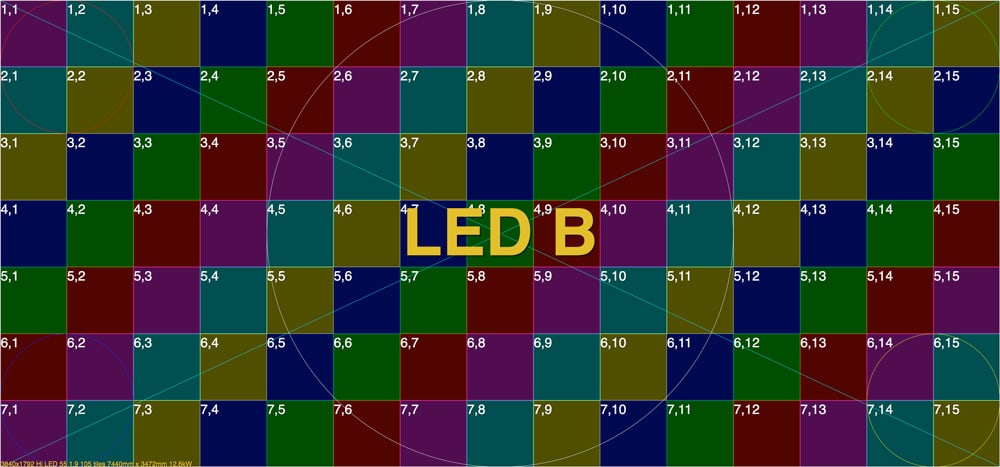
Each video wall will have a technical pack showing the exact pixel dimensions of each surface, along with a tile map. On a recent exhibition stand project, for example, the brief covered three separate canvases that together formed a walk in structure: a rear top banner at 4608 by 512 pixels, a front facing main structure at 3840 by 1792 pixels, and an internal immersive room at 4096 by 1280 pixels. Each one was built from a different number of LED tiles and had its own resolution specification.
None of these figures are round numbers you would default to in a standard aspect ratio or resolution. Video content for LED walls needs to be designed to the pixel, rather than simply scaled up or down to fit. Get this wrong and you end up with content that is stretched, cropped in the wrong place, or simply doesn’t fit the panel it was built for.
Creating Video Content for Wraparound LED Walls
Imagine video content covering three sides of a structure, where a visitor can walk inside and see video above them and across the surrounding walls. This is a good example of what makes LED video wall content different from standard video production. You are not designing one video. You are designing a set of coordinated videos that need to feel like a single environment when someone is standing inside it.
That means thinking about where a visitor’s eyeline naturally falls, what they will see first as they approach, and how content should behave differently on a ceiling mounted surface compared with a wall in front of them. It also means working out, panel by panel, what will be visible from a standing position on the show floor and what will be lost behind stand furniture, structural supports or simply the angle a visitor is standing at. An event company will often ask us to map this out and show the client exactly what is visible and what isn’t before production even starts.
The same thinking applies to smaller formats too, like a cuboid display suspended above a stand, where content on the top face is only glimpsed from certain angles and the side faces do most of the communicating.
From brief to delivery: what the process looks like
Once we understand the structure, we build a template that mirrors the exact tile layout and resolution of each surface, including where the panel joins and any angles sit. Content is then edited to that template from the start, not adapted afterwards. This is why a single event stand can result in three, four or more separate video deliverables rather than one file: each surface usually needs its own edit, timed to work alongside the others rather than in isolation.
It’s also important that every pixel of the video wall is mapped to one pixel of content, which is what gives the best possible resolution. Some studios now generate footage using AI for good reason, but very few AI platforms currently produce video at the resolution these walls need. The result can look softer or less defined than footage made specifically to fit the screen.
We also build in a bit of flexibility from the outset. Stand builds sometimes shift slightly between the initial specification and the final install, so we keep source files organised in a way that makes late changes to timing or crop straightforward rather than a full re-edit.
Key takeaways
Creating video content for LED video walls requires a different starting point to standard video production: the structure comes first, and the content is built around it rather than the other way round.
- Every LED surface has its own resolution, tile count and aspect ratio, and content needs to be designed to match it exactly
- Angled joins and edges between panels need to be understood before filming, not fixed in the edit
- Wraparound and multi surface structures usually need several coordinated videos, not one
- Visibility mapping (what a visitor can and can’t see from the show floor) should happen before production starts
- Keeping editable source files gives you flexibility if the stand build changes late in the process. With AI-generated footage, making significant changes may mean generating the content again.
Let’s talk about your LED video wall
If you have an LED screen or wall brief from an event company, or a structure you are still working out how to fill with content, we are happy to take a look. Everything starts with a conversation, so get in touch and we can talk through what your surfaces need before you commit to a production plan.
ABOUT THE AUTHOR:

Matt Downer
Matt is our Production Manager. He manages video projects from the first phone call through to the final edit. He brings a blend of creativity, logistical knowhow and a passion for all things video-related. Matt loves running, cooking and watching Back to the Future.
Let’s talk about your video project
Every successful video starts with a conversation.
Tell us what you’re trying to achieve, and we’ll help you shape the right approach.